Papers I've been working on,

Publication

KAIST Introduction to Reinforcement Learning · Project ·

(Solving Korean Four-Ball Carom Billiards with Reinforcement Learning: Meta-Pretrained Initialization under Sparse Rewards)

Doyeol Oh, Byungmo Kang, Seojun Park

TBD

KAIST Automated Software Testing · Project ·

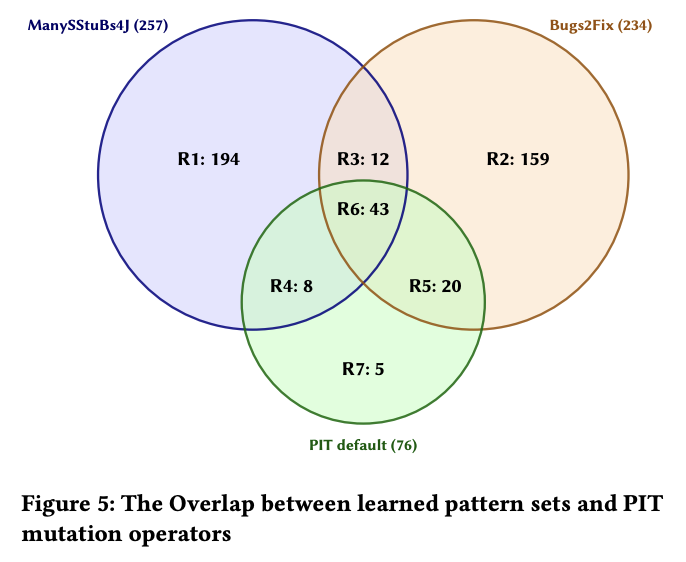
(ASTraMut: AST-Guided Mutation Testing for Java)

Doyeol Oh, Hyunji Park, Junseo Jang, Dongjae Lee

TBD

KAIST Introduction to Artificial Intelligence · Assignment 3 · Pacman Competition Award ·

Capture-the-Flag Pacman with Self-Play Tuned Heuristics

Doyeol Oh

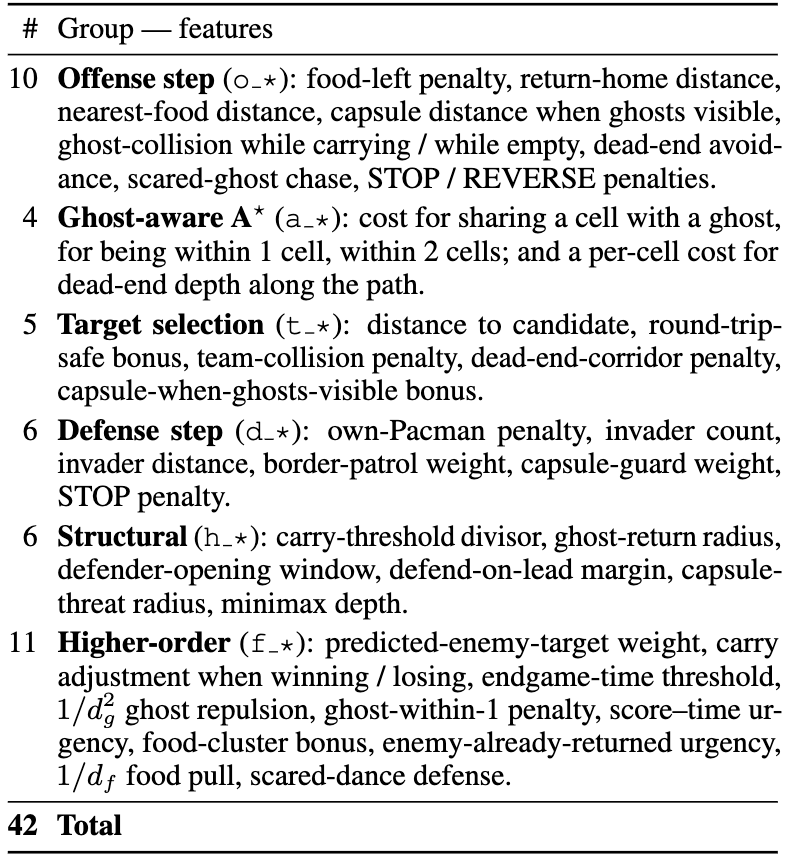
A two-vs-two CTF Pacman team built on classical search — goal-commit A* offense, alpha-beta minimax defense, 42-feature linear evaluator — plus a held-out verification protocol designed to defeat zoo-overfitting. The contribution is treating the student round-robin as an unseen distribution head-on, generalizing via hand-inspectable weights and external anchors instead of deep RL.

papers/pacman3.png

KAIST Introduction to Artificial Intelligence · Assignment 2 ·

Multi-Agent Search for Pacman: Reflex, Minimax, and Alpha-Beta

Doyeol Oh

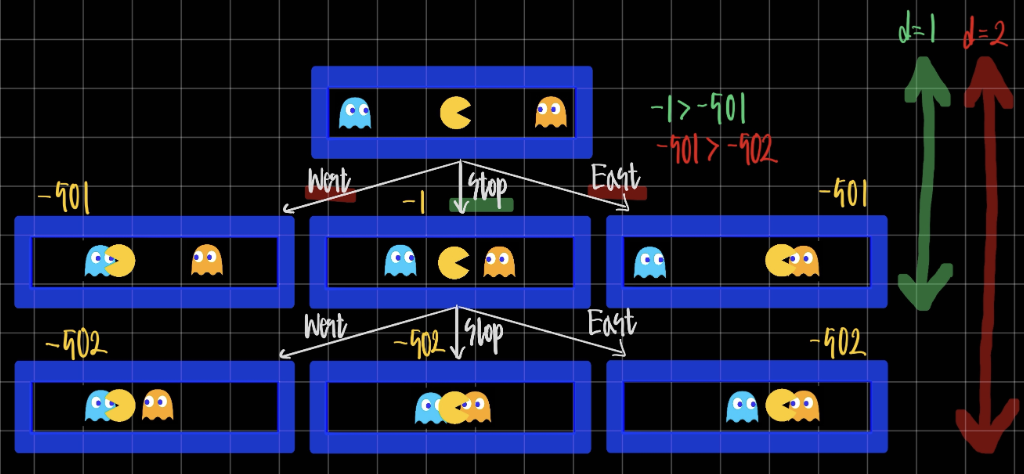
An analysis that disentangles three effects commonly conflated in adversarial Pacman: action ordering has two dimensions (pruning efficiency vs tie-breaking), minimax is brittle against random ghosts via pessimism cascade rather than evaluation quality, and on trapped layouts the −1 living penalty creates a "swift-death preference" that makes deeper search rush a ghost.

papers/pacman2.png

KAIST Introduction to Artificial Intelligence · Assignment 1 ·

Graph Search for Pacman: DFS, BFS, UCS, and A*

Doyeol Oh

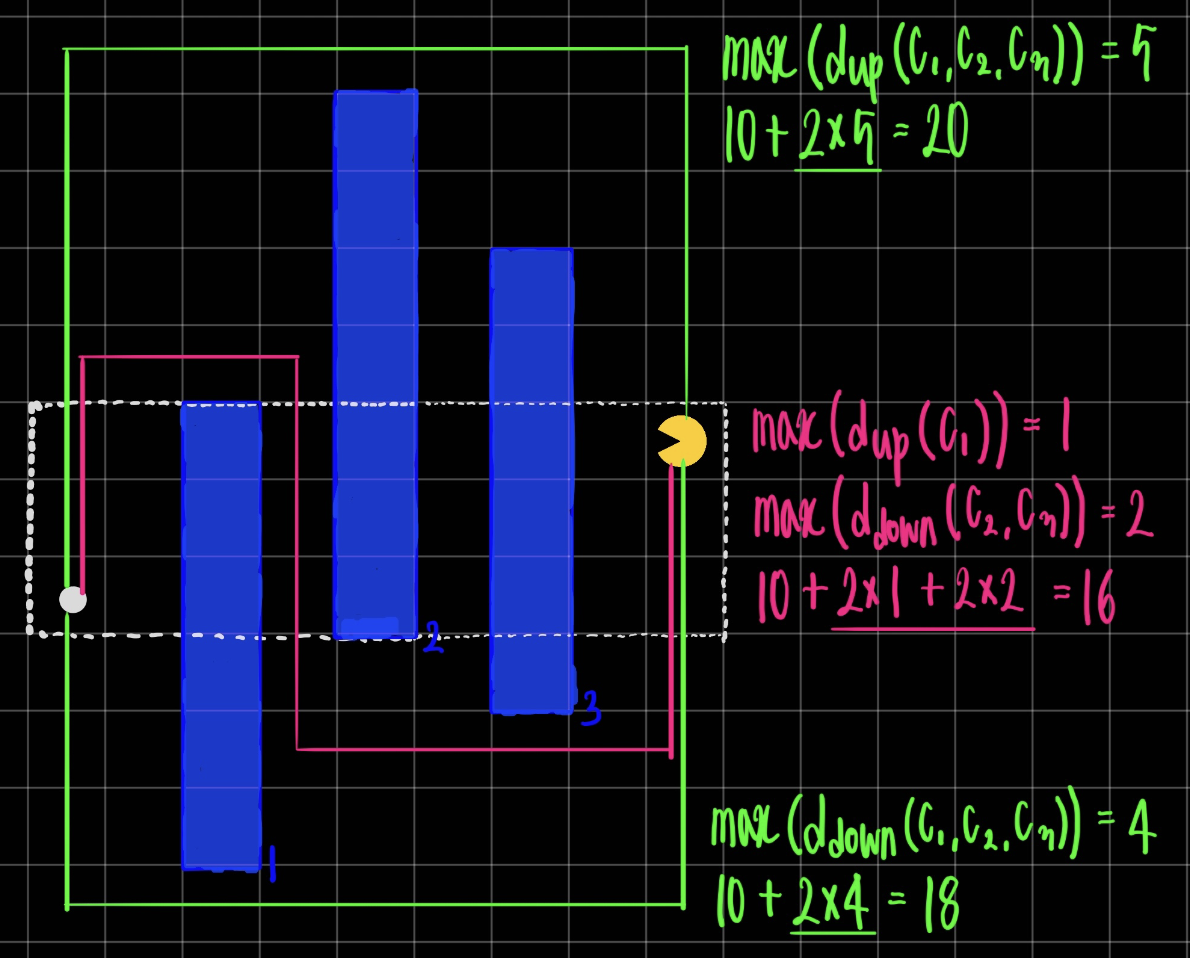
DFS / BFS / UCS / A* on the CS188 framework, plus a custom admissible heuristic — Blockage Detection + Tarjan articulation-point Portal Detection + dead-end peeling — that expands 34.4% fewer nodes than Manhattan on average. Per-call preprocessing made wall-clock time worse for single queries, a clean illustration of the search-quality vs evaluator-cost tradeoff.

papers/pacman1.png

UNIST Machine Learning · Final Project Report ·

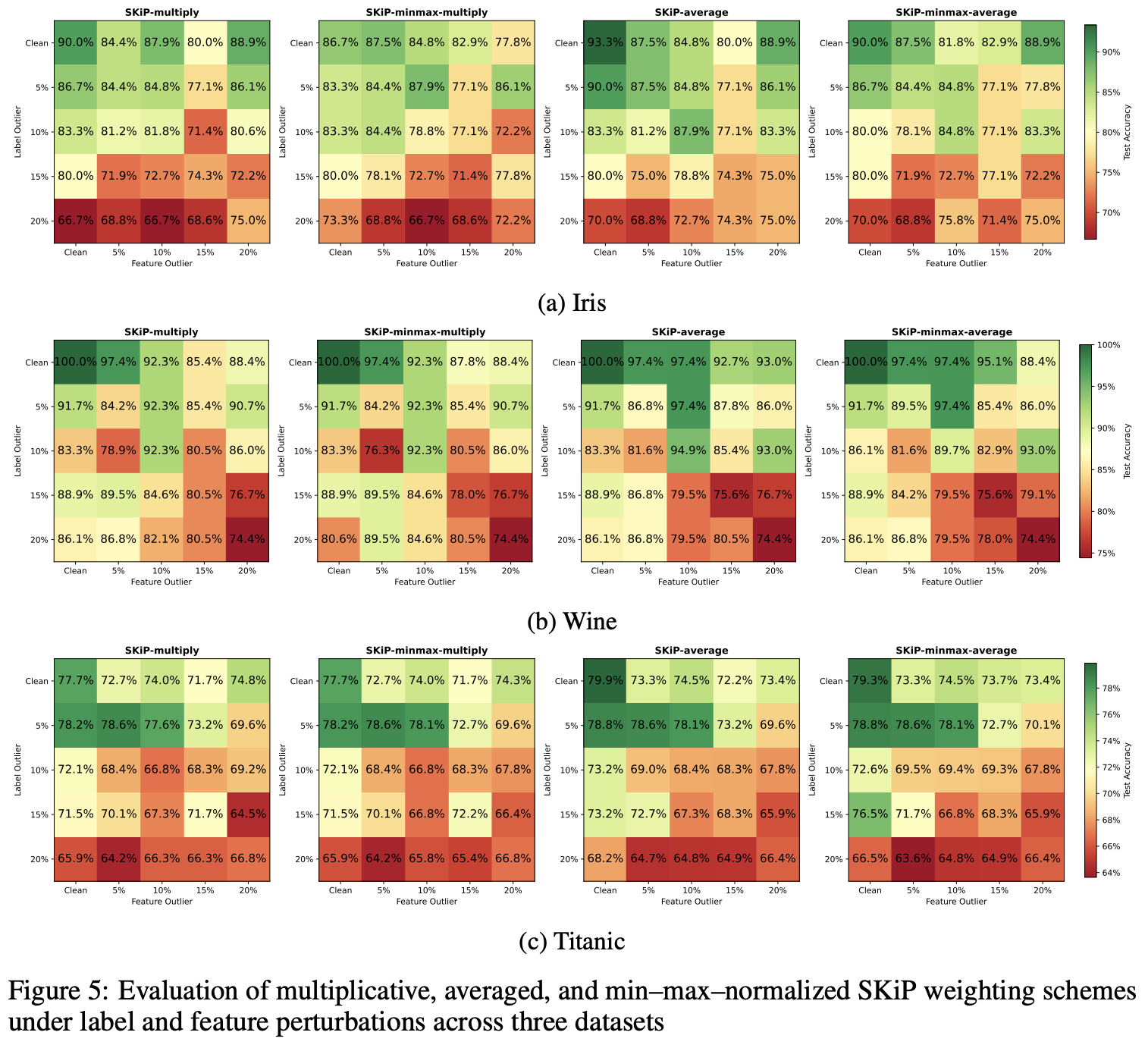
SKiP: SVM weighted by K-Nearest-Neighbors and class Probability for weakening outliers

Doyeol Oh, Jeonghoon Park, Jaemin Kim, KangJun Lee

A weighted soft-margin SVM with slack penalty C_i = C · (p_i + n_i) / 2, where p_i is a class-conditional Gaussian probability (catching feature outliers) and n_i is a KNN label-consistency score (catching label outliers). The novelty is the additive aggregation: a multiplicative form collapses when either signal breaks (e.g. the Gaussian assumption on Titanic), while the average lets the surviving signal carry the weight.

papers/skip.png

Korean Database Conference (KDBC) 2025 ·

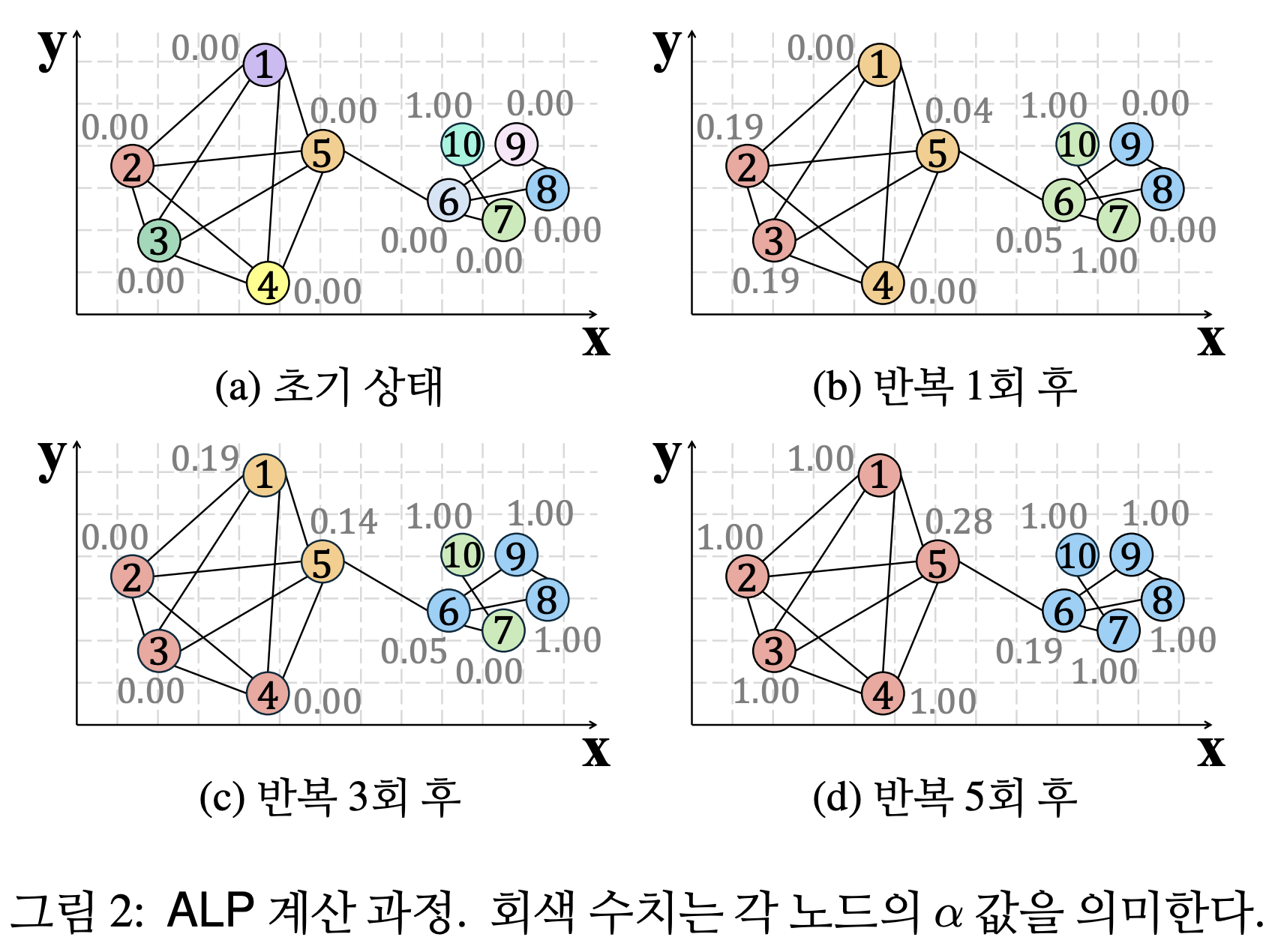
Entropy-Guided Adaptive Label Propagation for Location-Aware Graph Clustering

Doyeol Oh, Hyewon Kim, Dahee Kim, Junghoon Kim

An adaptive label propagation for LBSN where each node's structural-vs-spatial weight is α = 1 − H/log|L|, derived from the entropy of its neighbor labels. When neighbors agree, the Jaccard structural term dominates; when they disagree, the Haversine spatial term takes over — visually separating structurally connected but geographically distant cities (e.g. Nashville vs. Atlanta).

papers/alp.png

UNIST Introduction to Algorithms · Best Paper Award ·

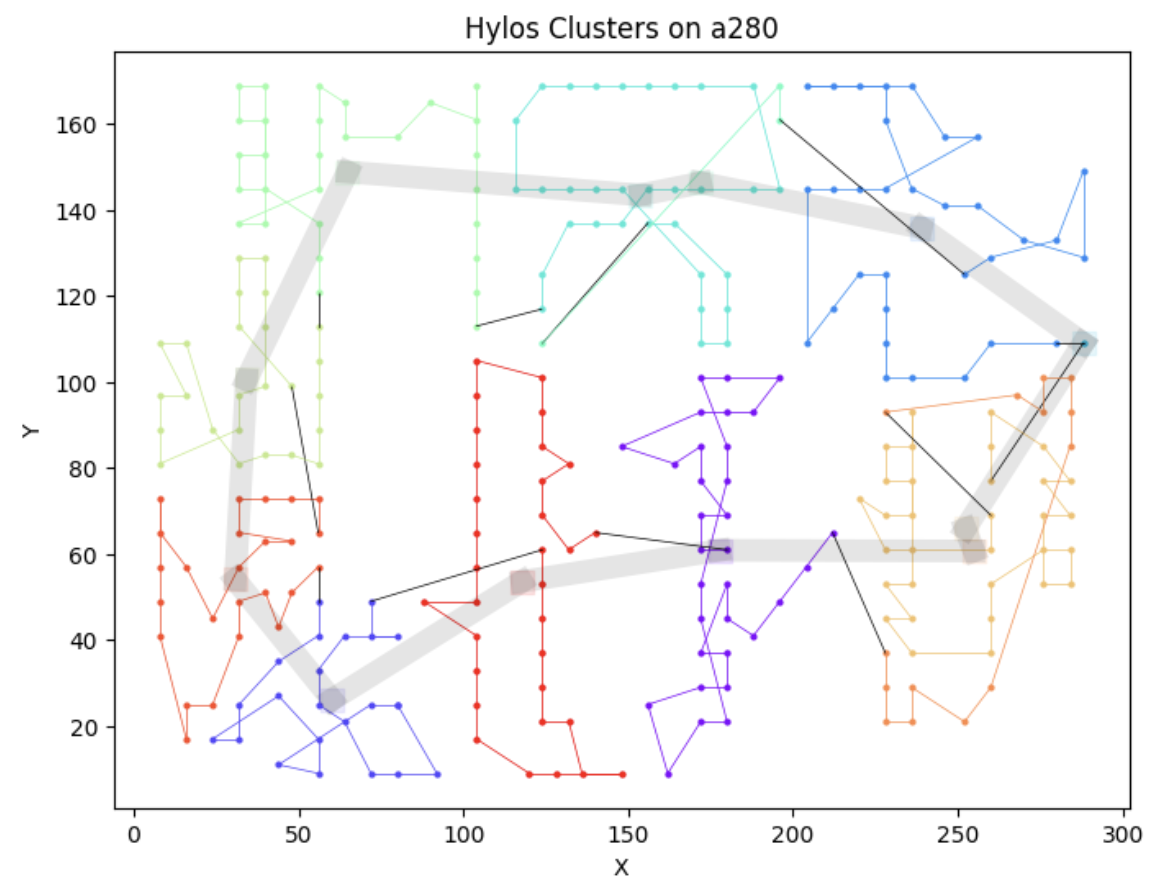
Hylos: Hierarchically Localized Optimization Strategy for TSP

Doyeol Oh

A four-stage hierarchical TSP solver: k-means partitions cities into clusters of size ≤ 22 so Held-Karp becomes feasible, then both inter-cluster and intra-cluster tours dispatch by size between Held-Karp and Christofides, with a final entry/exit alignment to minimize cluster-boundary transitions. On mona-lisa100k it is ~8× faster than Christofides at ~2% lower cost. Won UNIST CSE331 Best Paper Award.

papers/hylos.png

UNIST Introduction to Algorithms · Assignment 1 ·

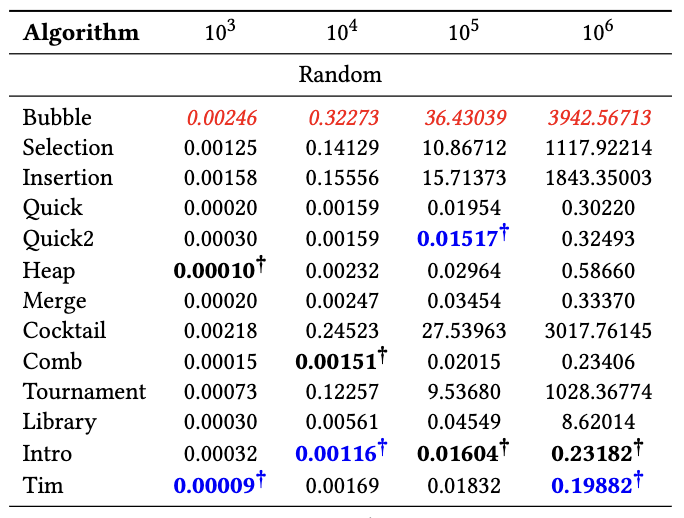
Comparative Study of Twelve Sorting Algorithms

Doyeol Oh

A C++ benchmark of twelve sorts across random / sorted / reverse / partial inputs from 10³ to 10⁶. Two findings worth keeping: vanilla Lomuto Quick crashes on sorted input from unbalanced recursion (median-of-three pivoting is practically required), and a naive multithreaded Tim variant ran slower than single-threaded Tim because thread-creation overhead dominated the merge gain.

papers/sort.png

ICROS (Institute of Control, Robotics, and Systems) 2024 ·

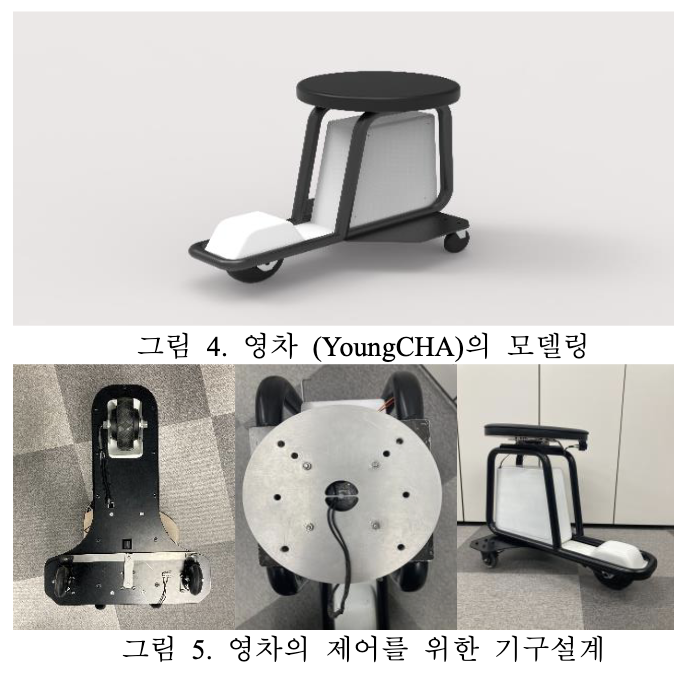
Development of Intuitive Steering Mechanism for Hands-Free Operation of Indoor Shared Mobility

Donghoon Nam, Doyeol Oh, Seongjae Lee, Yunjeong Gwak, Huisung Lee

A chair-shaped indoor mobility with hands-free steering: a potentiometer reads saddle rotation and an STM32F303RE drives a PID-controlled steering motor, and the throttle is replaced by a kick-to-start scheme. Both hands and feet stay free while moving, and the form factor lets you sit and rest the moment you stop.

papers/youngcha.png

Patent

System and Method for Spatially Proximate Community Detection Based on Entropy-Weighted Adaptive Label Propagation

KR 10-2026-0027653 · Filed 2026-02-11