Here's who I am...
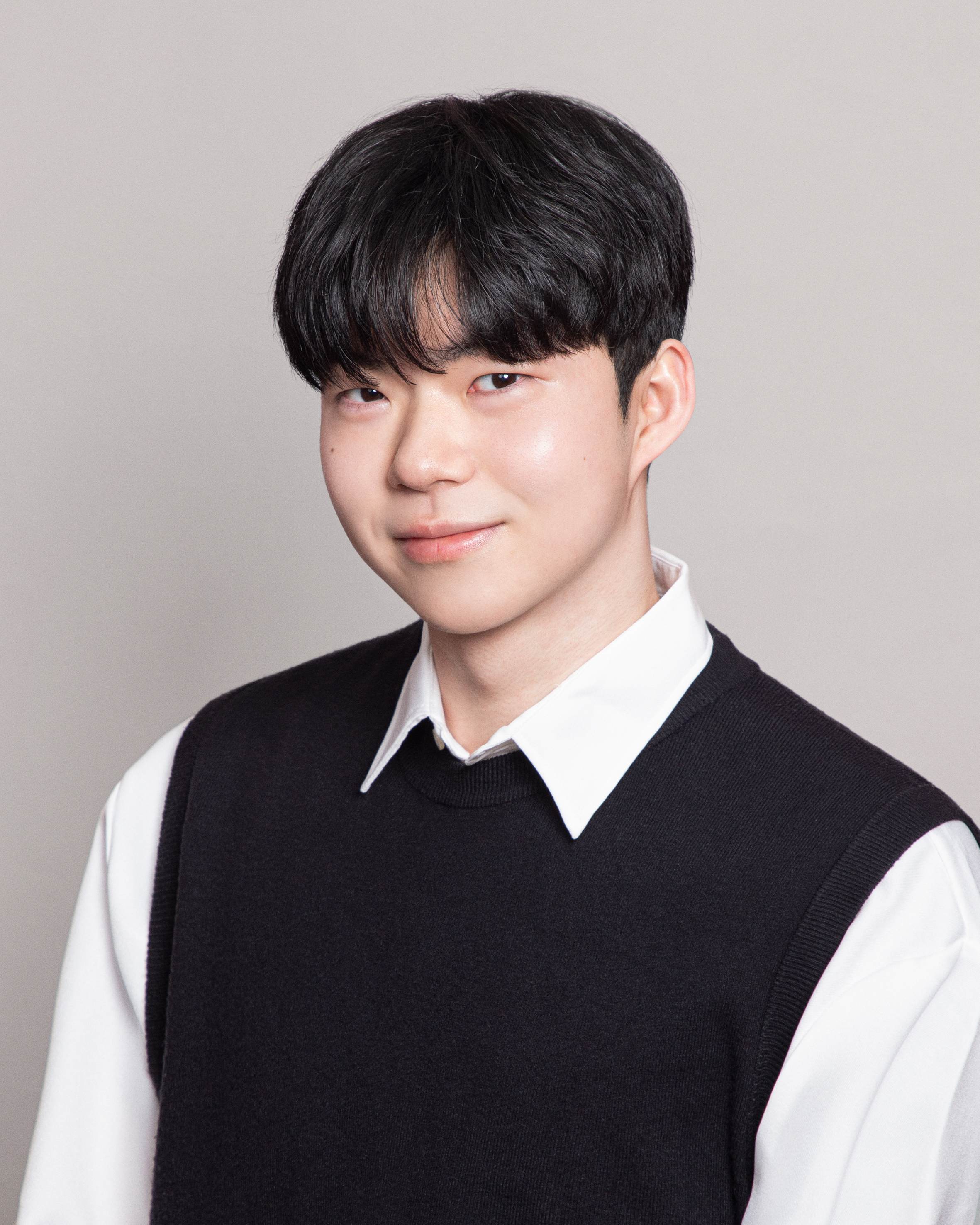
My name is Doyeol Oh. Or simply Danny.
I'm an undergraduate at UNIST in the Department of Computer Science and Engineering, currently working as a Data Engineer at Config Intelligence.
Computer science is, to me, the most elegant abstraction of a complex world. I'm interested in modeling how humans interact with the world. I enjoy observing how different people think and what they value, and I want to express that in code.
My papers so far keep circling that same question — how to abstract some slice of human-world interaction into something an algorithm can actually run. The shape changes (search, RL, optimization, robotics), the question does not. List of publications →
I make a lot of side projects too — for class or hackathons, at work, and sometimes just because the idea wouldn't sit still. List of projects →
As another way of understanding people, I read a lot of fiction, watch films, and study plays — I used to act in a theater club. On Sundays, I serve at church.
Education
Research Interest
My research interest centers on modeling how humans interact with the world — so that intelligent agents can learn to do the same. What I enjoy is taking the structure of human cognition, action, and language as it grips the environment, and translating it into a form an algorithm can actually run.
The two methods closest to that question, in my view, are RLHF and robotics. RLHF treats human preference as a supervisory signal — the way to turn "what people want" into something a model can be trained against, anchoring an agent in our intent. Robotics treats the body as the medium where interaction actually happens — the place where every assumption a model carries is pressure-tested against physics, and where the gaps in that model become visible. The two grip the same problem from opposite ends: signaling intent on one side, embodying it on the other.
Around this core sit three adjacent fields. Video Understanding is the input problem — letting models read human behavior and context as it unfolds over time. HCI is the interface problem — how a learned agent should breathe alongside the people it works with. Safe AI is the responsibility problem — the boundaries inside which a trained agent must operate.
On the long horizon, these five meet in the same place: AGI.
Experience
Award
KAIST Office of Student Affairs & Policy, Office of Student Life, Office of Academic Affairs ·
KAIST AI Future Challenge Idea Competition
First Prize, Provost’s Award, 「Cognitive Immune AI」
Ministry of National Defense, Republic of Korea ·
National Defense Public Data Competition
Minister of Defense Award, 「Military Welfare Map」 (Service Development)
UNIST · BTS (BrainToSociety) Research Program · UNIST ·
2nd U-Challenge Festival · 2nd X-Corps Plus Festival
Gold Prize · Bronze Prize, 「YoungCHA」
OUTTA ·
OUTTA AI Bootcamp
1st cohort, Top Team & Top Participant (1st / 27 teams · 5th / 61 participants)
Certificate
Ulsan Information Industry Promotion Agency ·
White Hacker Training Program
1st-place team in final CTF competition
9roomthonUNIV · goorm ·
9roomthonUNIV UNIST
Frontend Instructor
Programming
Programming started, for me, with games. I loved open worlds — GTA V most of all — enough that in middle school I opened Unity to try building one of my own. That's when I learned the thing that has stayed with me: what I'd actually fallen for wasn't the game on screen, but the act underneath it — taking a principle or problem from the world, modeling it mathematically, and watching the model come alive inside a machine. That moment is the start of my life as a developer.
In college the fascination shifted from games to services — web and apps. There's a particular catharsis in seeing an idea become a working thing in days instead of months, and I chased it. I held onto that during military service, too: at a base 800 meters up a mountain, I taught myself Next.js, React, and Tailwind in the evening hours we were allowed online. The identity I was building, then, was the developer who turns a social problem into shipped software, fast.
By the time I was discharged, the world had changed. Generative AI had arrived, and the skill I had spent years sharpening — shipping fast — was no longer scarce. I started a frontend job with Claude open beside me, and the shift became impossible to ignore. For a while I doubted whether building, on its own, could still be a craft I could call mine.
Eventually I came back to the starting point. What I had loved as a kid wasn't shipping; it was abstraction — taking the world, restating it in math, then writing it into code. The thing in paragraph one. So I chose to live as a researcher. The shipping skill didn't disappear; it became the other hand of the same craft. Today I'm trying to be someone who abstracts the world through research and ships those results into UX-aware software, fast — with AI sitting between the two hands as a tool.
Tech Stack
- Frontend
- React · Next.js · Styled · TailwindCSS
- Mobile
- Flutter · React Native
- Infra
- Vercel · Supabase · GCP
- Embedded
- C · MBED · Arduino · Raspberry Pi
- AI
- NumPy · PyTorch · Gymnasium
- Tool
- Git · Docker · Figma · Notion · Linear · Claude Code · Vim
This website
Built with Astro, Pretendard Variable for type, Radix Colors for the palette, and a small homemade grid on top of raster.css.