

Background
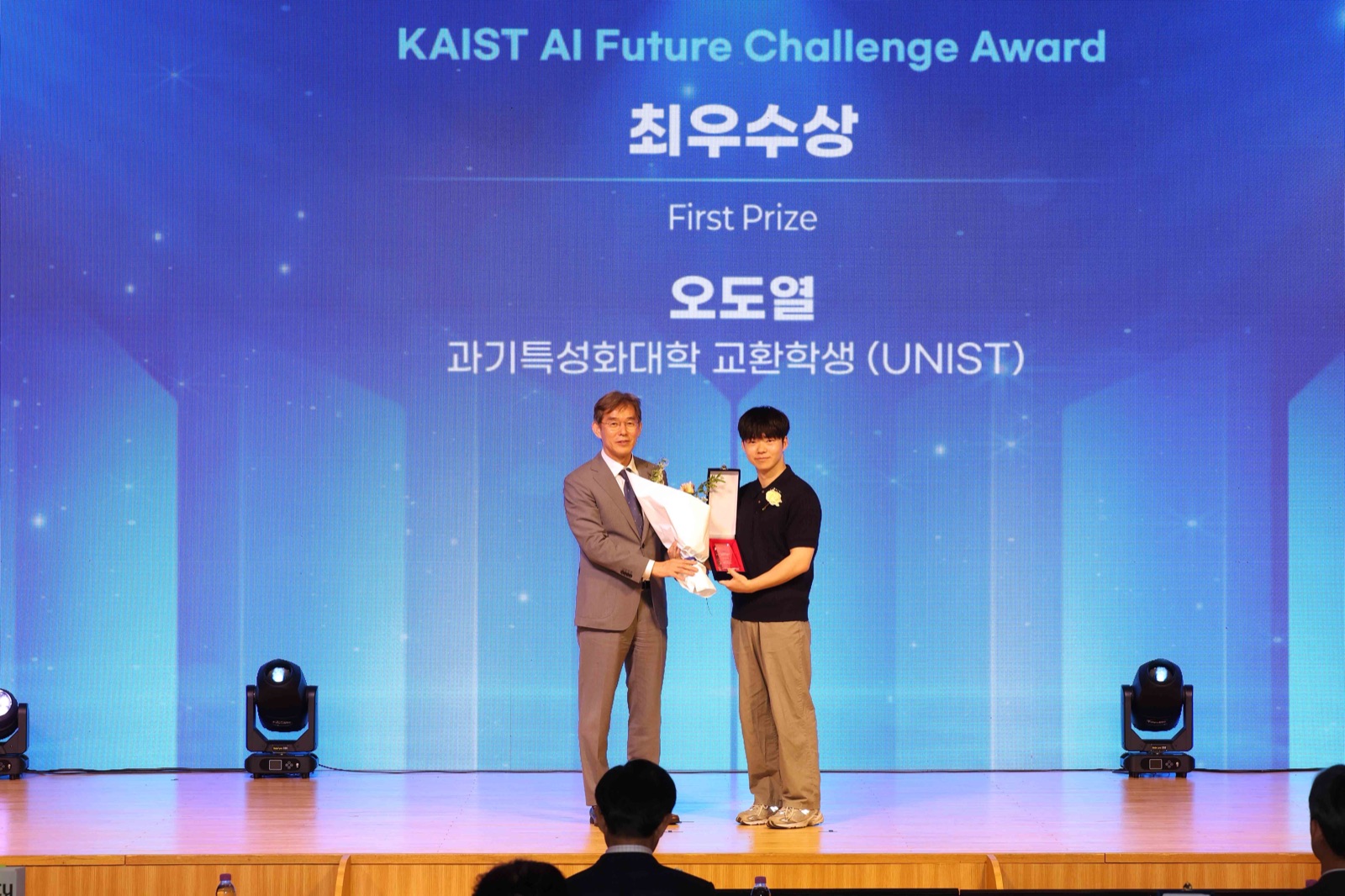
At the AI Future Challenge Idea Competition — co-hosted by KAIST’s Office of Student Affairs & Policy, Office of Student Life, and Office of Academic Affairs — I won the First Prize (Provost’s Award) with 「Cognitive Immune AI」. I also got to present the same idea at the following Education Innovation Day. The slides are here (PDF).
If I had to put 「Cognitive Immune AI」 in one line — it’s an AI design philosophy where the more it helps you, the more your thinking grows. The idea leans on two classics from learning psychology: Bjork’s Desirable Difficulty and McGuire’s Inoculation Theory. Just as exposure to a weak antigen builds immunity, small cognitive challenges build the muscle of independent thinking. That metaphor is where the name “Cognitive Immune” came from.
Where it started — before writing any code
The idea began with a single scene. One day, working remotely, I caught myself leaning on AI way too much while coding. I got the answer. But the logic behind that code didn’t stick in my head. How did a tool that was supposed to help end up making me weaker? That question was the starting point.
The first neurological evidence of LLM impact on the brain
It could have just been me, so I went looking for data. The 2025 paper from MIT Media Lab — “Your Brain on ChatGPT: Accumulation of Cognitive Debt” (Kos’myna et al., arXiv:2506.08872) was reporting the same signal. With 54 participants, they measured the strength of information flow between brain regions through alpha-band EEG. The result: the AI-assisted writing group had the lowest brain connectivity. The sample size has its limits, but — this is the first neurological evidence that LLM impact has reached the brain itself.
This isn’t like the calculator
“Calculators and search engines didn’t feel any different at first, did they?” — fair question. Calculators took over mental math. Search engines took over memory. Both were natural delegations. But today’s AI is taking over not just math and memory, but problem definition, critical judgment, and creative reasoning too. What cognitive work is even left for the user? — that’s a question we still haven’t answered.
Two foundations from learning psychology
So what principles should the solution rest on? Half the answer was already in learning psychology.
- Bjork (1994) · Desirable Difficulty. Too easy and we just glide past it; too hard and we give up. The right amount of challenge in between is what strengthens learning and memory.
- McGuire (1964) · Inoculation Theory (used as analogy). Just as exposure to a weak antigen builds resistance, small cognitive challenges strengthen the mind.
→ Challenge is immunity. A good AI should know how to make us a little uncomfortable.
What existing tools are missing
There are tools in a similar spirit. But each of them is missing a square.
| Tool | What it is | Default-on | General-purpose |
|---|---|---|---|
| Khanmigo | A learning AI that asks step-by-step questions instead of giving answers | Learning mode only | Education only |
| Duolingo | A gamified language-learning app | Learning mode only | Language only |
| Cursor Plan Mode | A mode that makes you plan before writing code | Has to be toggled on | ✓ |
| Claude thinking | A mode that shows reasoning before answering | Has to be toggled on | ✓ |
| Cognitive Immune AI (this proposal) | — | On by default | All tasks |
The single differentiator of this proposal — a general-purpose AI that automatically injects cognitive challenge into everyday work.
Solution 1 · Personalized intensity
The right intensity of challenge is different for everyone. So the AI has to read the user’s state first. Four signals:
- Time spent writing solo before calling the AI — how much they tried on their own
- How much of the answer they accept as-is — are they pasting AI output without editing?
- Repeated requests for the same kind of hint — are they asking for the same help over and over?
- How fast their questions grow harder — are they pushing into harder problems over time?
These four signals get added to RLHF reward as a “cognitive engagement” term, mixing hints and counter-arguments appropriately. In emergency or accessibility situations it automatically falls back to direct-answer mode. The four signals cross-validate each other and get verified again against output quality — so reliability holds up.
Solution 2 · Nudge-based autonomy
“On by default” might sound like coercion. So the key is flipping the default.
| Tool | Default | Actual use |
|---|---|---|
| Cursor / Claude thinking | Normal mode | Mostly normal mode (toggling is friction) |
| Cognitive Immune AI | Challenge mode | Mostly challenge mode + one toggle for normal mode |
Thanks to the Default Effect (Thaler · Nudge 2008) from behavioral economics, people rarely change defaults. So the default itself produces the “automatic” effect — and at the same time, since it’s one toggle away, it isn’t coercion. One single difference — the default. That one thing makes it automatic without forcing.
Solution 3 · Cognitive Independence Index (CII)
“Has the user actually grown?” If you can’t measure it, you can’t verify it. So the four signals above get weighted-averaged into a 0–100 score — the Cognitive Independence Index (CII).
CII = 0.30 · log(edit time)
    + 0.25 · (1 − acceptance rate)
    + 0.25 · (1 − hint repetition)
    + 0.20 · Δcomplexity
The weights get calibrated through later experiments. To put it in a metaphor — it’s the BMI of AI usage. Just as BMI gauges health from weight and height, CII gauges independence of thought from AI usage patterns. So far we’ve only measured how much AI we use. CII is the first attempt to measure how well we use it.
How to actually build it
No new model needed. Just one middleware layer on top of existing LLMs.
| Component | Implementation |
|---|---|
| Direct signals (edit time · acceptance rate) | Collected as events from the IDE / browser |
| Interpreted signals (hint repetition · question difficulty) | Separate analysis — cluster similar questions, or evaluate with a low-cost LLM |
| CII calculation | Weighted average of 4 signals, shown live on the user’s screen |
| Cognitive engagement reward | No retraining needed — validate at the prompt layer first → only fold into RLHF after the effect is confirmed |
| Deployment | VS Code Extension · Chrome Extension · LLM Wrapper |
The validation path is an A/B test splitting users into two groups and comparing CII deltas on the same tasks.
Closing
「Cognitive Immune AI」 is an attempt to redefine AI not as a human-replacement tool, but as an environment for human growth. Someday, the standard for a good tool might have to change. Not by how well it replaces the user, but by how much it grows the user.